Meta & Fysikken: Afsnit 116: COP 30, klimanyt og mos
1: COP30
2: Tysklands største Hydrogen fabrik
3: Skrumpende havis
4: Kelp farming in Norway
5: Canada og mos
6: Energi fra Vulkaner
7: Vulkanudbrud i Afrika
---------------------------
1:COP30
No, the long-term goal of keeping global warming below 1.5 degrees Celsius is likely no longer possible, as the world is already experiencing warming that is very close to, or has already temporarily surpassed, this threshold. Scientists state that while temporary spikes above 1.5° degrees are happening, achieving this as a long-term average will require drastic and immediate emission reductions that are not currently on track.
What is happening now
The global average temperature has already surpassed 1.5 degrees Celsius in some individual years and months, according to recent data.
The World Meteorological Organization (WMO) forecasts a high probability that the next five years will exceed this limit on average, which is a significant warning sign, though the 1.5°C Paris Agreement goal refers to a 20-year average.
Some studies suggest that a single year exceeding the 1.5°C mark indicates that the long-term threshold may have already been breached.
Why it's unlikely to be met
Current national climate commitments, if fully implemented, are projected to lead to a much smaller reduction in emissions than what is needed to meet the 1.5°C goal.
To align with the 1.5 C pathway, global emissions would need to fall by about 55% by 2035, which is far greater than the 12−15% reduction projected under current commitments.
What is the outlook for the future
Even if the 1.5°C goal is not met, it is still possible to limit warming to a much lower level, such as 1.6°C, 1.7° C, or 1.8°C, which is significantly better than scenarios with much higher warming.
The consequences of exceeding the 1.5°C threshold will include more frequent and intense heatwaves, wildfires, storms, and irreversible damage to ecosystems like coral reefs.
The world is on track to potentially exceed the 1.5° C goal within the next decade.
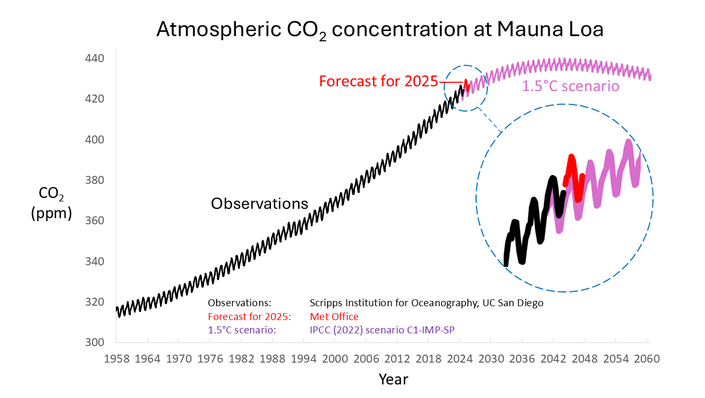
CO2 Status:
—————-
2: Tysklands største Hydrogen fabrik:
Germany's largest commercial renewable hydrogen factory is the 10 MW plant in Schwäbisch Gmünd, opened by Lhyfe in October 2025. The facility can produce up to 4 tons of renewable hydrogen per day and is Lhyfe's largest outside of France.While it's the largest operational commercial plant, there are larger-scale projects planned for the future in Germany, such as a 130 MW plant planned for Prenzlau by ENERTRAG.
https://engineerine.com/largest-green-hydrogen-plant/
A green hydrogen factory is good for the climate because it can be produced using renewable energy, with zero greenhouse gas emissions, and can replace fossil fuels in sectors that are hard to electrify, like heavy industry. When used in a fuel cell, hydrogen only releases water vapor and warm air, making it a clean energy carrier that can also store and deliver renewable energy.
#
Hydrogen Fuel Cell makes electricity directly. They also produce water vapor, heat and, depending on the fuel source, very small amounts of nitrogen dioxide and other emissions.
————-
3: Skrumpende havis
https://nyheder.tv2.dk/klima/2025-10-21-skrumpende-havis-er-katastrofe-men-kan-have-fordel
-------------------------
4: Kelp farming in Norway
————
5: Canada og mos:
———
6: Energi fra Vulkaner:
Iøvrigt:
7: Vulkanudbrud i Afrika
Volcanic activity has both short-term cooling and long-term warming effects. Volcanic eruptions can release gases like sulfur dioxide (\(SO_{2}\)), which create aerosols that reflect sunlight and cause temporary global cooling, as seen after the Mount Pinatubo eruption. However, volcanoes also release carbon dioxide (\(CO_{2}\)), a greenhouse gas that contributes to warming, though the amount from volcanoes is significantly less than human-generated \(CO_{2}\). Short-term cooling effects Sulfuric acid aerosols: Eruptions inject sulfur dioxide into the stratosphere, where it reacts with water to form tiny sulfuric acid droplets.Reflection of sunlight: These aerosols act like a global "umbrella," reflecting incoming solar radiation back into space and causing a temporary cooling effect that can last for several years.Examples: The 1991 Pinatubo eruption caused a global cooling of about \(0.5^{\circ }C\) for a year, and the 1815 Tambora eruption led to "the year without a summer" in 1816. Long-term warming effects Carbon dioxide (\(CO_{2}\)): Volcanoes release \(CO_{2}\), a greenhouse gas that traps heat in the atmosphere, contributing to global warming.Minor contribution: The \(CO_{2}\) emitted by volcanoes is a very small fraction of the total greenhouse gases in the atmosphere, with human activities being the dominant source. For example, the \(CO_{2}\) from the Pinatubo eruption was only about half of what humans produce in two days