Meta & Fysikken: Afsnit 127: AI, WetWare & Datacentre
Vi lægger lige ud med at omtale det danske CPR-læk. Og det fører os frem til dagens øvrige punkter. Herunder kommer Karina’s noter til dagens afsnit.
1: The Pro-Human AI Declaration
2: AI Data centers
3: Wet Ware, brain cells integrated in a computer and fungi computers.
4: Gross Domestic Regeneration -a regenerative GDP economic Model
1: The Pro-Human AI Declaration
Lad os gaa igennem denne side sammen.
2: What is an AI Datacenter:
An AI data center is a specialized physical facility designed specifically to handle the massive, computationally intensive workloads required to train and run artificial intelligence models. Unlike traditional data centers that focus on general-purpose data storage, web hosting, and cloud applications, an AI data center acts more like a single, massive integrated supercomputer.
Because artificial intelligence—especially Large Language Models (LLMs) and generative AI—requires processing trillions of calculations simultaneously, the entire architecture of these facilities must be fundamentally engineered differently than standard IT environments.
Key Differences: Traditional vs. AI Data Centers
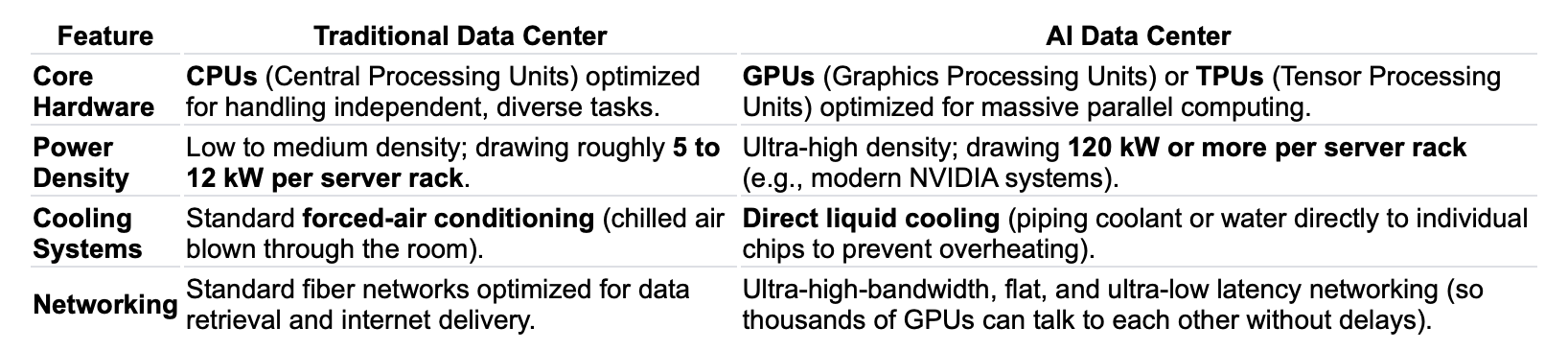
The massive global AI boom has triggered a historic wave of capital investment, with hyperscalers like Microsoft, Google, and Amazon spending hundreds of billions of dollars to build out these facilities. Because their power demands are so extreme, modern AI data centers are deeply reshaping regional energy grids and driving a heavy push toward dedicated clean energy infrastructure.
3: Wetware Computing (Biocomputers)
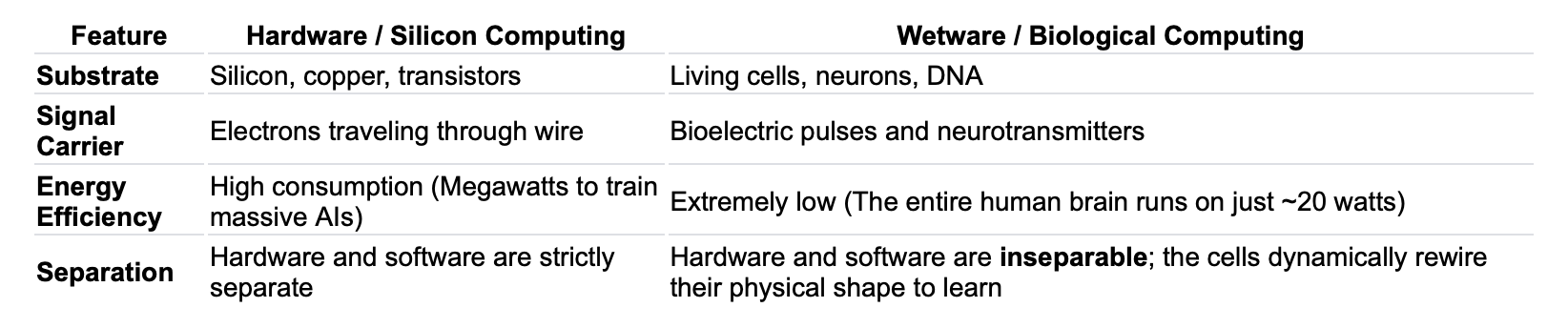
In modern computer science and bioengineering, wetware computing is a cutting-edge reality where scientists build physical computers that utilize living, biological neurons to process data.
Instead of writing artificial neural networks (ANNs) on silicon chips, engineers take lab-grown clusters of brain cells (called brain organoids) or biological neurons and attach them to electrical grids via multi-electrode arrays.
To understand how these biological processors operate and learn in real time, see this demonstration of how neurons interface directly with computer hardware:
https://youtu.be/5Sd3JlLJn9Q?si=Gx98bNfJrCCTg8eK
Traditional vs. Wetware Computing
Real-World Progress
Wetware is shifting from theory into practice:
The Pong Experiment: Biotech startups like Cortical Labs have grown human and mouse neurons on chips (called DishBrain), training them to successfully play the vintage arcade game Pong. [1]
Wetware-as-a-Service (WaaS): Companies like FinalSpark have built "Neuroplatforms" that keep brain organoids alive in specialized incubators for months, allowing researchers worldwide to run computational code through living cells via a digital cloud API
A side note:
Fungi computers (or mushroom computers):
Currently operating as experimental prototypes in advanced scientific laboratories rather than consumer products.
Falling under the umbrella of unconventional computing and bioelectronics, a fungi computer utilizes the underground, root-like filament network of a mushroom, the mycelium, as a biological substrate to process, store, and transmit information.
4: Gross Domestic Regeneration
4a: What is GDP:
Gross Domestic Product (GDP) is the total monetary or market value of all final goods and services produced within a country’s borders during a specific period, usually a quarter or a year. Essentially, it serves as a comprehensive scorecard of a nation's economic size and overall output.
Standard Components
Calculated most commonly via the expenditure approach, GDP tracks the sum of four core economic forces:
Consumption (C): Private consumer spending by households (e.g., food, rent, medical expenses).
Investment (I): Business spending on capital, equipment, and home construction.
Government Spending (G): Public expenditures on infrastructure, defense, and government employee salaries.
Net Exports (X - M): The value of a nation's total exports minus its total imports.
GDP = C + I + G + (X-M)
4b: What is GDR ( Gross Domestic Regeneration)
Gross Domestic Regeneration is an idea introduced by Tenzin Seldon, a venture capitalist who invests in climate technology.
The core concept: Seldon's model aims to redefine standard Gross Domestic Product (GDP). It places a concrete financial value on the natural world, including land, water, ocean, glaciers, to incentivize regeneration rather than enviromental exploitation.
Designed to sit alongside or replace standard Gross Domestic Product (GDP), GDR shifts the foundational question of economics from "how much did we produce?" to "what did our activity leave stronger than before?"
Traditional accounting under GDP creates a "half-ledger" system where extracting resources, suffering climate disasters, or paying healthcare costs all register as economic growth. In contrast, Seldon's model mathematically links long-term productive capacity to systemic restoration.
The Three Pillars of GDR
Seldon's model evaluates a company or national economy across three interdependent, core pillars:
Ecological Regeneration (Nature): Measures the health and recovery of natural infrastructure. Key indicators include net carbon positions, forest cover, soil organic matter, water purity, and biodiversity trends.
Social Regeneration (People): Examines the health and cohesion of communities. It focuses on narrowing wealth gaps, improving public health metrics, strengthening community bonds, and expanding access to capital.
Capital/Economic Regeneration (Livelihoods): Evaluates the true resilience of the economy, ensuring it can absorb macroeconomic shocks while generating stable, long-term livelihoods rather than short-term extractive gains.
The Multiplicative Logic
A distinguishing technical feature of Seldon’s GDR framework is its mathematical compounding mechanism. Rather than averaging the performance of the three pillars, the scores are multiplied.
\(\text{GDR\ Score}=\text{Ecological\ Score}\times \text{Social\ Score}\times \text{Capital\ Score}\)
This structural safeguard means:
No Subsidies for Destruction: A hyper-profitable firm or booming financial district cannot rely on a strong balance sheet to mathematically offset an exhausted watershed or exploited workforce.
Systemic Exposure: If any single pillar drops toward zero, the total score collapses, forcing investors and policymakers to account for the holistic failure.
Economic Justification & Durability
Seldon frames GDR not as a purely ethical initiative, but as a framework for smart capital and long-term asset valuation. She illustrates this using the analogy of two farms:
One farmer strips the soil of nutrients to maximize short-term yields; production looks stellar on paper, but the land's capacity eventually collapses.
The second farmer rebuilds the organic soil matter season by season; yields compound over time, meaning the long-term value of the asset rises.
Under GDR, companies that regenerate their inputs experience falling externalized costs over time (e.g., lower reliance on synthetic fertilizers, higher retention of stable labor), whereas extractive competitors inevitably face skyrocketing operational risks and costs. The final goal of the model is to align cash incentives directly with planetary stewardship so that capital naturally flows toward systemic preservation.